
06 Mar Equity and Excellence Framework
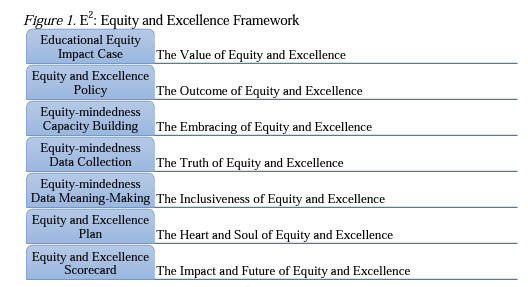
E2: Equity and Excellence Framework
By Adrienne Coleman & Traci Ellis
Both the United States and the United Nations have identified, examined, and put out a call to action to address the educational inequities that have disproportionately and negatively affected racially minoritized students, as well as those from a lower socioeconomic background, and poorer countries. Data from the Nations Report Card and the Global Monitoring Report provide evidence of disparities in academic performance and access to equitable educational resources. The outcome of these inequities impacts countries throughout the world, as their residents will not possess the skills and knowledge to thrive in a rapidly evolving global society, nor possess the critical thinking and analytical skills to solve the problems of the world. Considering there is a national and global equity focus, the Illinois Mathematics and Science Academy engaged in a process of participatory action research to institutionalize and operationalize equity and excellence, ultimately addressing educational inequities. This resulted in the development of the E2 : Equity and Excellence Framework, inclusive of the following equity pathway steps: Educational Equity Impact Case, Equity and Excellence Policy, Equity-mindedness Capacity Building, Equity-mindedness Data Collection, Equity-mindedness Meaning-Making, Equity and Excellence Plan, and Equity Scorecard. This framework is a comprehensive, research-informed, equity-minded, inclusive pathway towards advancing educational equity that centers the voices of those with the most risk of experiencing inequities. Educational institutions that want to confront, diminish, and potentially eliminate educational inequities can apply this scalable and adaptable framework. Keywords: equity, educational equity, educational inequity, inclusive education, excellence Introduction Equity was initially introduced in scientific literature in 1948, but it was not until 1990 that there was national and global focus on it, beginning with the evolution of equality to equity. Subsequently, in 2004 more countries began to conceptualize equity within the context of education (Jurando de los Santos, Morento-Guerrero, Marin-Marin, & Costa, 2020). While this focus on educational equity has existed for nearly twenty years, educational inequity persists, disproportionately affecting marginalized communities including students of color and low-income students, as well as students who live in less developed countries. Specifically, in the United States, it has been reported that the education system is failing to provide equitable opportunities and outcomes (ECCBN, 2016; Bauman et al., 2005). Regarding students of color, the National Association of Diversity Officers in Higher Education (2021) reports that they have negative experiences in education that lead to lower academic persistence, retention, and graduation rates. In addition, both lower income and students of color are underperforming on state and national assessments (Plucker, Hardesty, & Burroughs, 2013). The Association of American Colleges and Universities (2015) states: Expanding access to quality education is key to making opportunity real for all. It is key to closing America’s deepening divides, strengthening the middle class, and ensuring our nation’s vitality. Yet at all levels of U.S. education, there are entrenched practices that reinforce inequities—and that lead to vastly different outcomes for low-income students and for students of color. We are failing the very students who must become our future leaders.
To learn more about Dr. Adrienne Coleman and her research please visit this page
Sorry, the comment form is closed at this time.